Ruth – Chapter 3 – Having Faith
Last week we discovered that Boaz is a relative of Elimelech, and, as such, can be a kinsman redeemer for Naomi and Ruth. He has granted Ruth great favor and she has gathered a lot of grain in his fields through both the barley and wheat harvest. The time period for both harvests is about 4-6 weeks. During this time, Ruth has been under Boaz’s protection and provision. As we will see in this study, Naomi sees him as much more than that.

Vs. 1-5 Ruth’s mother-in-law Naomi said to her, “My daughter, shouldn’t I find security for you, so that you will be taken care of? Now isn’t Boaz our relative? Haven’t you been working with his female servants? This evening he will be winnowing barley on the threshing floor. Wash, put on perfumed oil, and wear your best clothes. Go down to the threshing floor, but don’t let the man know you are there until he has finished eating and drinking. When he lies down, notice the place where he’s lying, go in and uncover his feet, and lie down. Then he will explain to you what you should do.” So Ruth said to her, “I will do everything you say.”
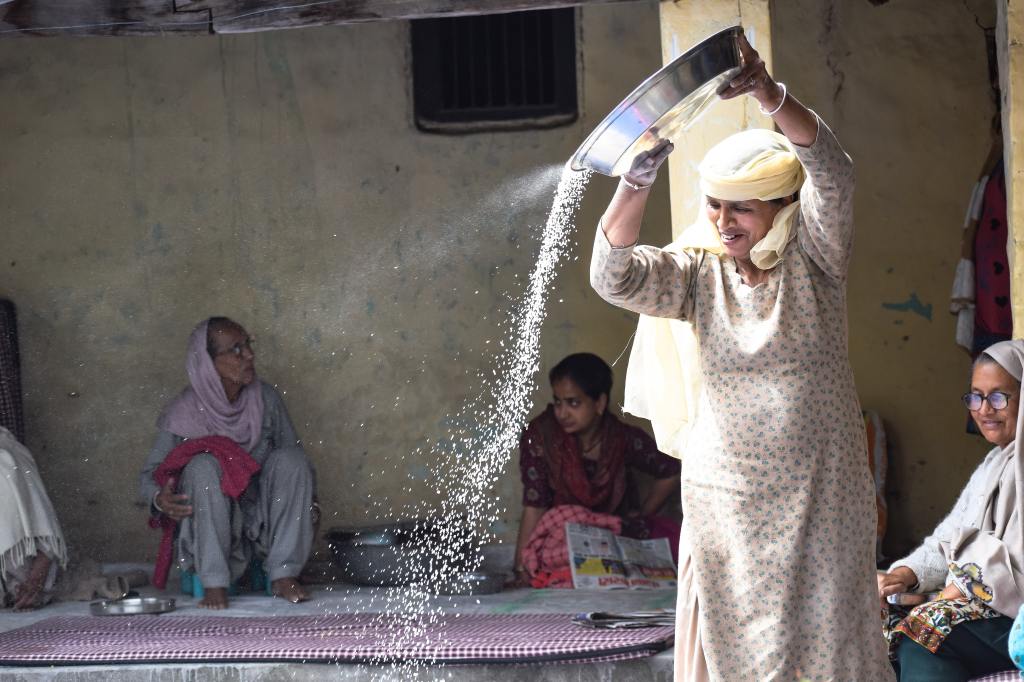
Ruth has been working along side Boaz’s servant girls gathering grain for herself and Naomi. This grain will need to last the full year, so she has been winnowing, and storing the grain for future use. As a person who owns a grain company, I know how hard she’s working. It will take a lot of grain to sustain the two women for the year. Now the season is over and all the grain has been brought in. All that is left to do is thresh it. You can imagine Naomi has been hatching a plan from the moment she found out Ruth was gathering in Boaz’s fields. She knows the Lord has provided this food source for them, but she also knows it could be a lot more. She approaches Ruth and says, “My daughter, shouldn’t I find security for you, so that you will be taken care of? Now isn’t Boaz our relative? Haven’t you been working with his female servants?” The word for security is manoach, which means, a resting place. This is the same word she used when she told Orpah and Ruth to go home to their families. She wanted them to find manoach – a resting place. Her desire then, and now, is for Ruth not to have to bear the burden of provider and worry about what tomorrow might bring. She wants Ruth to have security and a future. And so, she conceives a plan to obtain that rest for her daughter-in-law who has been so faithful to her.
As we read through her plan, we might stop and wonder what in the world is going on. She’s asking Ruth to do what?? to which Ruth’s response is “I will do everything you say”?? For a little background, we must remember that family connections in this culture are everything. Family members had certain responsibilities toward one another. One such responsibility is as a goel or kinsman redeemer. The goel had a specifically defined role in a Israeli household. He was to buy back from slavery a fellow kinsman. He was responsible to avenge a murder. He was responsible to buy back a kinsman’s land that had been forfeited. And, according to Deuteronomy. 25:5-6, “When brothers live on the same property and one of them dies without a son, the wife of the dead man may not marry a stranger outside the family. Her brother-in-law is to take her as his wife, have sexual relations with her, and perform the duty of a brother-in-law for her. The first son she bears will carry on the name of the dead brother, so his name will not be blotted out from Israel.” In short, a goel (kinsman redeemer) is a near relative who is charged with the duty of restoring, recovering or avenging the rights or wrongs committed against someone. In the end, it could cost the kinsman redeemer a lot – even his life. And Naomi sees Boaz as someone who could be their goel. Her instructions to Ruth, while strange to us in this day and age, would make perfect sense for all parties involved. This was not a wanton sexual advance Naomi was asking of Ruth. This was a right they had to petition a near kinsman to redeem them and their situation. Naomi understood at the very beginning that Boaz was a near kin and a possibility. This is why she had hope. She waited because she wanted to make sure Boaz was the right kind of man – honorable, and a man who would give Ruth – and her – rest and security. Over the course of the barley and then the wheat harvest, she became sure Boaz was the right choice. Now the ball was in Ruth’s court so to speak. Can she trust Naomi? Does she have faith in Naomi’s choice? She does, and so she takes that step of faith to secure the rest they both need.
Vs 6-9 She (Ruth) went down to the threshing floor and did everything her mother-in-law had instructed her. After Boaz ate, drank, and was in good spirits, he went to lie down at the end of the pile of barley. Then she went in secretly, uncovered his feet, and lay down. At midnight, Boaz was startled, turned over, and there lying at his feet was a woman! So he asked, “Who are you?” “I am Ruth, your slave,” she replied. “Spread your cloak over me, for you are a family redeemer.”
It seems a strange ritual. Go in, uncover the man’s feet and lay down. Then ask him to spread his cloak over her as her goel. What does it all mean, and how is it significant for us today? First, we must understand there were no women on the threshing floor at night – only the men who would be taking turns guarding the grain. We also have to understand this was a great time in the harvest season – a time of celebration, so there would have been some eating and some drinking of wine. Boaz in is good spirits when he lies down to get a little sleep. Then Ruth comes in and secretly goes to Boaz. This is so she will not humiliate herself or Boaz. In this, she shows her integrity. She comes in, uncovers his feet and lays down – a sign of humility and submission. She is in a precarious position as a widow, and though it is her right to ask for a goel, she does not presume it to be granted. Then she waits. Boaz awakens at midnight and is startled – there is someone here. “Who are you?” he asks. Her answer once again shows her true character. “I am Ruth, your slave”. The word for slave here is ama–teka – a word meaning handmaiden or female servant. She does not presume to demand her rights. She instead, begins her petition in humility. Then she asks him to spread his cloak over her. The word for cloak is actually kanaph which means wing. It is a picture of a mother bird spreading her wings over her babies. In Psalm 17:8-9, David references a song of Moses in Deuteronomy 32:10-12 when he asks God to, “Protect me as the pupil of Your eye; hide me in the shadow of Your wings from the wicked who treat me violently, my deadly enemies who surround me.” A picture of God’s mercy is his mercy seat where two cherubim spread their wings and cover the ark. Again, Psalm 57:1 says, “Be gracious to me, God, be gracious to me, for I take refuge in You. I will seek refuge in the shadow of Your wings until danger passes.” Jesus in Matthew 23:37 says, “Jerusalem, Jerusalem! She who kills the prophets and stones those who are sent to her. How often I wanted to gather your children together, as a hen gathers her chicks under her wings, yet you were not willing!” This picture resonates with me – and with anyone else who owns chickens. I found that a mama chicken will protect her chicks no matter what. She will literally wrap them up in her wings to keep them warm, and protected from outside aggressors – especially other chickens! Believe me, you don’t want to mess with a mama chicken’s babies!! This gives us a beautiful picture of what Ruth is asking of Boaz. But there is something even more in this poetic request. She is also asking Boaz to marry her – a literal proposal. One of the reasons this word wing is translated cloak is because during the marriage ceremony the groom would spread his cloak – or tallit over his new wife as a sign that she was under his protection and household. At times, this is still used in today’s Jewish marriage ceremony. During the final blessing, the couples parent’s may wrap the tallit around their shoulders as a symbol of unity. So what is Boaz’s reply to this proposal?

Vs.10-15 Then he said, “May the Lord bless you, my daughter. You have shown more kindness now than before, because you have not pursued younger men, whether rich or poor. Now don’t be afraid, my daughter. I will do for you whatever you say, since all the people in my town know that you are a woman of noble character. Yes, it is true that I am a family redeemer, but there is a redeemer closer than I am. Stay here tonight, and in the morning, if he wants to redeem you, that’s good. Let him redeem you. But if he doesn’t want to redeem you, as the Lord lives, I will. Now lie down until morning.” So she lay down at his feet until morning but got up while it was still dark. Then Boaz said, “Don’t let it be known that a woman came to the threshing floor.” And he told Ruth, “Bring the shawl you’re wearing and hold it out.” When she held it out, he shoveled six measures of barley into her shawl, and she went into the town.
As Naomi suspected, Boaz shows himself an honorable, upstanding man of integrity. Just what she wants for this special daughter-in-law! When Boaz first met Ruth he called her my daughter and he does so here. This is a term that shows us he has been, and still is, willing to provide protection and provision for her. He then says, “You have shown more kindness now than before, because you have not pursued younger men, whether rich or poor.” This shows us that Boaz is most likely a lot older than Ruth – perhaps more of an age of her father. This may burst some bubbles – I think we all want the romantic story of two beautiful young people falling in love. But this is much more about mutual respect and faith than romantic attraction. Naomi had faith that Boaz would do the right thing by Ruth and her. She knew of his character and put her trust in it. Ruth had also had a least a month to observe Boaz’s character and willingly put her faith in pursuing this avenue of protection. Here Boaz and Ruth live up to their reputations. He is a noble man of integrity who does not take advantage of the situation and promises to take care of everything. She shows her character by not pursuing younger men, which would mean forgoing the kinsmen redeemer route and marrying anyone putting into jeopardy Elimelech’s name. He also speaks of her reputation in the town – “since all the people in my town know that you are a woman of noble character.” The word for noble is hi-yil, a word that continues to come up in this book – Ruth, the Moabites, is known as a virtuous woman by all the town. She has overcome their preconceived ideas of what a woman of Moab is like. She has shown herself to be a woman of great character. The Boaz goes on to be the man who is highly respected in the community. He will not let her reputation be tarnished in any way. He says to the other men guarding the grain with him, “Don’t let it be known that a woman came to the threshing floor.” And finally, he goes the extra mile by giving her 6 measures of barley to take home to Naomi. He would not send her away empty handed. We do not know how much barley he gave her, but it was certainly enough to continue to sustain Ruth and Naomi for a while.
Vs. 16-18 She went to her mother-in-law, Naomi, who asked her, “How did it go, my daughter?” Then Ruth told her everything the man had done for her. She said, “He gave me these six measures of barley, because he said, ‘Don’t go back to your mother-in-law empty-handed.’” Naomi said, “My daughter, wait until you find out how things go, for he won’t rest unless he resolves this today.”
When she returns home to Naomi and shares all that had happened Naomi advises her to wait to find out how things turn out. The word for wait is sebi which means to sit or remain. Boaz had informed Ruth that, although he is indeed a kinsman redeemer, there is someone else who is closer. Imagine with me for a moment: You have taken this huge step to basically propose to this guy and then you are told – yes, but… there might be someone else… It could cause a bit of anxiety. Who is this other man? What if he isn’t a man like Boaz, someone who I trust and has this wonderful reputation. What kind of household would I be in now. I can’t take it back, but… Naomi must have seen her anxiety, so she assures her. Don’t worry – just sit and wait. Boaz will take care of this today. In fact, he will not rest until it is resolved. Naomi has been given a new faith – She had lost everything and thought it was the consequence of the decisions Elimelech made to go to Moab. She went away full and returned, so she thought, empty. What she didn’t see at the time was she came back with Ruth. And through Ruth, God was going to bless her – even more than she imagines. She sees God’s goodness, even in the most dire situation, and now she has faith. He will see them through.

There are many times when we can’t see how a horrible situation can bring goodness. We are so blinded by the bitterness around us and our eyes are downcast – woe is me. What use to be naom (pleasant) is now mara (bitter). Paul reminds us in Romans 8:28 We know that all things work together for the good of those who love God: those who are called according to His purpose. The word work together is synergio – where we get our word synergy. Synergy is an interaction or cooperation giving rise to a whole that is greater than the simple sum of its parts. In other words, God works in all things, the good, the bad, the ugly, and He blesses and redeems them to work for our good – even more than we can imagine. Think of Daniel in the lion’s den or Shadrach, Meshach and Abednigo in the fiery furnace. Their circumstances seemed grim, but out of it came, not only a rescue, but a recognition of God by the king. A whole that was greater than the simple sum. It reminds me of a song I am hearing on the radio right now called Famous For by Tauren Wells and Jenn Johnson. One line in the songs is “Make way through the waters Walk me through the fire. Do what You are famous for. What You are famous for.” God is famous for making a way when there is no way. Instead of looking downward, or around us, our eyes should be “kept on Jesus, the source and perfecter of our faith, who for the joy that lay before Him endured a cross and despised the shame and has sat down at the right hand of God’s throne.” Hebrews 12:2. Let us look to God, the source of our faith. Let us keep our eyes on Him, for He will sustain us, justify us, redeem us, and perfect us. Let’s not get caught up in what is going on around us – becoming anxious as if all of this will destroy us. It will not because He was not. Jesus conquered sin and death. This is what we celebrate each Easter. This is what the Passover celebrates – Christ who came as the Lamb of God to atone once for all so we might have eternal life though Him. Amen and Amen!
 Bible Study Blog