Ruth Chapter 4 – The Beginning…
We have come to the end of this amazing book. We started out with a family leaving their home for “greener” pastures only to find devastation. Naomi has left full and returned empty. She has gone from naom – pleasant to mara – bitter. Only Ruth has come back with her and she is an outsider – a Moabitess. But one month at home will bring on a mighty miracle. God is still at work in Naomi’s life. She thought she came home empty, but she actually came home with Ruth who puts her faith and future in Naomi’s God. Naomi will learn that God has a plan – and it is even bigger than they can imagine. When we left chapter 3, Boaz has sent Ruth home with 6 large scoops of barley and a promise that he will take care of everything. And here we are in chapter 4 where Boaz is keeping that promise.
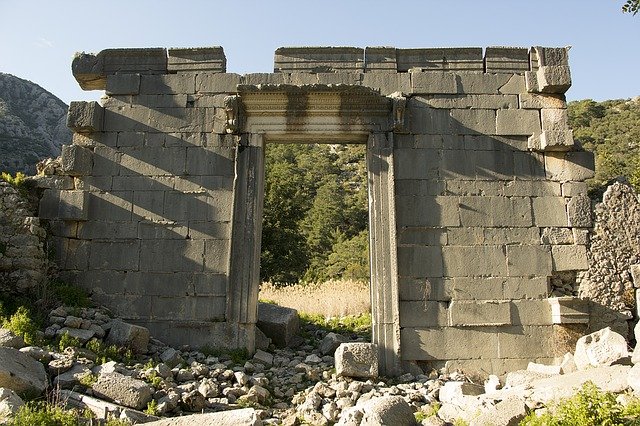
Vs. 1-12 Boaz went to the gate of the town and sat down there. Soon the family redeemer Boaz had spoken about came by. Boaz called him by name and said, “Come over here and sit down.” So he went over and sat down. Then Boaz took 10 men of the town’s elders and said, “Sit here.” And they sat down. He said to the redeemer, “Naomi, who has returned from the land of Moab, is selling a piece of land that belonged to our brother Elimelech. I thought I should inform you: Buy it back in the presence of those seated here and in the presence of the elders of my people. If you want to redeem it, do so. But if you do not want to redeem it, tell me so that I will know, because there isn’t anyone other than you to redeem it, and I am next after you.” “I want to redeem it,” he answered. Then Boaz said, “On the day you buy the land from Naomi, you will also acquire Ruth the Moabitess, the wife of the deceased man, to perpetuate the man’s name on his property.” The redeemer replied, “I can’t redeem it myself, or I will ruin my own inheritance. Take my right of redemption, because I can’t redeem it.” At an earlier period in Israel, a man removed his sandal and gave it to the other party in order to make any matter legally binding concerning the right of redemption or the exchange of property. This was the method of legally binding a transaction in Israel. So the redeemer removed his sandal and said to Boaz, “Buy back the property yourself.” Boaz said to the elders and all the people, “You are witnesses today that I am buying from Naomi everything that belonged to Elimelech, Chilion, and Mahlon. I will also acquire Ruth the Moabitess, Mahlon’s widow, as my wife, to perpetuate the deceased man’s name on his property, so that his name will not disappear among his relatives or from the gate of his home. You are witnesses today.” The elders and all the people who were at the gate said, “We are witnesses. May the Lord make the woman who is entering your house like Rachel and Leah, who together built the house of Israel. May you be powerful in Ephrathah and famous in Bethlehem. May your house become like the house of Perez, the son Tamar bore to Judah, because of the offspring the Lord will give you by this young woman.
Much of this is pretty perplexing. We are talking about city gates, sandals, land purchases and acquiring someone. So, let’s unpack this exchange. We start at the city gate. It was a common practice for legal matters to be settled at the city gates. This is for a couple of reasons. First, if you wanted to find someone, or cross someone’s path, you went to the city gate. Everyone in the town had to go in or out of that gate at least once a day. It was also common for redemption disputes to be settled with the elders at the city gates. Deuteronomy 25:7-10 says, “But if the man doesn’t want to marry his sister-in-law, she must go to the elders at the city gate and say, ‘My brother-in-law refuses to preserve his brother’s name in Israel. He isn’t willing to perform the duty of a brother-in-law for me.’ The elders of his city will summon him and speak with him. If he persists and says, ‘I don’t want to marry her,’ then his sister-in-law will go up to him in the sight of the elders, remove his sandal from his foot, and spit in his face. Then she will declare, ‘This is what is done to a man who will not build up his brother’s house.’ And his family name in Israel will be called ‘The house of the man whose sandal was removed.’ Here we find evidence of dealing with this issue at the gate, and of sandal removal. This gives us some clues as to what is going on. Boaz goes to the gate and sits and waits for the near redeemer to come through the gate. When he appears, he calls him over along with 10 elders. Why 10? It would be considered a minyon – a number that enables you to convene. Boaz was doing legal business, and he insured that everything was right – no cutting corners or leaving anything to chance. He then lays out the facts: Naomi has land to sell and this man is the first in line to redeem the land. Boaz is being very careful – he wants to make sure Ruth and Naomi are taken care of so he starts by putting something out that he knows the man wants – land. He then reveals the land comes with a stipulation – Ruth the Moabitess. Now, as Boaz probably suspected, the kinsman redeemer wants nothing to do with that. What he first sees as dollar signs, disappears when the facts are all presented. Every child Ruth would have reduces the inheritance of his own household so he steps back from redeeming the land and allows Boaz to take it along with Ruth. To make it clear, he takes off his sandal in the presence of the 10 witnesses and makes this a legally binding deal. Boaz accepts and it is done. Naomi’s land and Ruth is now his.

Vs 13-22 Boaz took Ruth and she became his wife. When he was intimate with her, the Lord enabled her to conceive, and she gave birth to a son. Then the women said to Naomi, “Praise the Lord, who has not left you without a family redeemer today. May his name become well known in Israel. He will renew your life and sustain you in your old age. Indeed, your daughter-in-law, who loves you and is better to you than seven sons, has given birth to him.” Naomi took the child, placed him on her lap, and took care of him. The neighbor women said, “A son has been born to Naomi,” and they named him Obed. He was the father of Jesse, the father of David. Now this is the genealogy of Perez: Perez fathered Hezron, Hezron fathered Ram, who fathered Amminadab, Amminadab fathered Nahshone, who fathered Salmon. Salmon fathered Boaz, who fathered Obed. And Obed fathered Jesse, who fathered David.
So Boaz takes Ruth as his wife and she gives birth to a son named Obed. Naomi’s life is now fuller than ever before. She is taken care of, has a son-in-law who is a man of integrity and high character and is now a grandmother. Her life has been fully redeemed. But what they do not know is how far this redemption is going to go. They only see what is now, but we are able to see what is to come. Obed is the father of Jesse who is the father of David. What began as emptiness, ends with a king. And not just any king – king David. A man who pursued God with all his heart. Finally, from David would come the King of all kings – Jesus the Messiah and ultimate Redeemer.
The next thing we see is a genealogy. The author of Ruth wants us to see the full picture – the full redemption of everything, for in the line of Boaz is David. What the author doesn’t see but we know is in the line of David is Jesus. Jesus, the Great Redeemer, is born in a line of those who were in need of redemption. It begins with Abraham and moves to Issac and Jacob. Jacob has a son named Judah and he is the father’s Perez. The fascinating thing about that, is Perez is a child who was born to Judah’s daughter-in-law – for he has became her kinsman redeemer. It is a story worth telling here and comes from Genesis 38. I give you the short version. Judah had three sons. His first son, Er, was given a wife named Tamar. He was evil and died leaving Tamar without a son. So, according to the custom, Tamar was given to the 2nd son so his brother’s name would continue, but the 2nd son was also evil and died. Judah did not want to give Tamar to his 3rd son for fear he too would die, so he lied to her and asked her to wait. After a while, she realizes she has been lied to so she decides to take matters in her own hands. She ends up tricking Judah into sleeping with her. In the end, when Judah finds out what she has done, he realizes he was in the wrong. Tamar has twins and her first born was Perez. Then the next few names in the family line eventually move to Egypt where they become slaves and are in need of redemption once again. And God does redeem them, only to have them not trust Him and wander in the desert for 40 years. The next name we read is Nahshon who appears to us in Numbers 1:7 as the head of his ancestral home and the son of Amminadab from Judah. He would go into the Promised Land, finding redemption from the wilderness wanderings. In the midst of the period of Judges when Israel goes from obedience, to disobedience, to disastrous captivity and then repentance again, Boaz is born. Instead of becoming a man of his time and culture he is a man of hiyil – integrity and character. He follows the God of all gods and becomes a redeemer himself. In the end – he redeems the line from which the the Great Redeemer would come.
Just when we think God isn’t in control, we find He does have a plan, and it will not be thwarted. All seemed lost – Naomi is alone and bitter. But God, in His infinite mercy, has a plan and it includes an obscure young Moabitess who loves her mother-in-law too much to let her go home alone. She steps out in faith and leaves everything behind to go to a place where there is no certainty. God loves that kind of faith! He shows her, Naomi and all of Bethlehem what is possible when one person steps out. All may seem lost and out of control right now. But God doesn’t see that. He is looking for those of us who are hiyil – people of integrity and character. He is looking for those like Ruth who will step out in faith. He is looking for those, like Boaz, who do not become people of our time and culture, but follow the One and only God. He has a plan and it will be accomplished. The question is – will it be accomplished through us? Will we be a part of His marvelous plan to see all redeemed? Will we be people who trust in him no matter what? I pray the answer is yes.
 Bible Study Blog