Treasures in Heaven

Vs 1-8 He also said to the disciples: “There was a rich man who received an accusation that his manager was squandering his possessions. So he called the manager in and asked, ‘What is this I hear about you? Give an account of your management, because you can no longer be my manager.’ “Then the manager said to himself, ‘What should I do, since my master is taking the management away from me? I’m not strong enough to dig; I’m ashamed to beg. I know what I’ll do so that when I’m removed from management, people will welcome me into their homes.’ “So he summoned each one of his master’s debtors. ‘How much do you owe my master?’ he asked the first one. “‘A hundred measures of olive oil,’ he said. “‘Take your invoice,’ he told him, ‘sit down quickly, and write 50.’ “Next he asked another, ‘How much do you owe?’ “‘A hundred measures of wheat,’ he said. “‘Take your invoice,’ he told him, ‘and write 80.’ “The master praised the unrighteous manager because he had acted astutely. For the sons of this age are more astute than the sons of light in dealing with their own people.
Here we have one of the more difficult passages in Luke. It appears as if Jesus is praising this unrighteous and less than honorable man. We know that isn’t the case, so, let’s break it down so we can discover exactly what is going on. Jesus is talking to his disciples, in the earshot, once again, of the Pharisees. We find Him telling them a story about a manager who was about to be fired. This guy had not been a good manager of the rich man’s possessions. The manager then is much like one today. They were the ones who basically ran the store for the owner. The problem with this guy is he was a lousy manager. Instead of making money, he was losing it. He knows when the rich man shows up he will be out on the street. This is a problem as he knows he isn’t good at really any other job, he isn’t strong enough to dig and begging is distasteful. So he devises a plan to secure his future. He will go to his master’s debtors and ingratiate himself to them by lowering their debts. By doing this, he will at least secure a future for himself whereby he will not have to dig or beg. Those men who owe the master will make a way for him to make a living. When the master gets there, he is quite impressed with this guys plan. The Greek word for praised here is epaineó, which means to applaud or commend. He says this unrighteous manager is astute or phronimos, which means one who is wise in the practical sense. The manager was still fired, but the owner grudgingly admired his ingenuity. Jesus is by no means recommending this type of unrighteous behavior to His disciples, but He uses it as an example, showing that the sons of this age, the men of this world, are more phronimos than the sons of the light. These guys understood something the disciples didn’t – how to deal with the men of this world.
Vs 9-13 And I tell you, make friends for yourselves by means of the unrighteous money so that when it fails, they may welcome you into eternal dwellings. Whoever is faithful in very little is also faithful in much, and whoever is unrighteous in very little is also unrighteous in much. So if you have not been faithful with the unrighteous money, who will trust you with what is genuine? And if you have not been faithful with what belongs to someone else, who will give you what is your own? No household slave can be the slave of two masters, since either he will hate one and love the other, or he will be devoted to one and despise the other. You can’t be slaves to both God and money.”

Jesus’ explanation of His parable can also need a bit of elucidation. So let’s go through this step by step. Let’s start by focusing on the comments He makes about His story. First, “for the sons of this age are more astute than the sons of light in dealing with their own people.” Jesus points out that when it comes to shrewdness, the people of the world will have Believers beat. They do not have the constraints of righteousness that we do. That is not to say that all Unbelievers deal unethically, but there is a focus on making money for the moment, rather than securing an eternal future. Without the view of the eternal, the fleeting moment becomes all important. Therefore, the sons of this age – or the sons that do not focus on the eternal, will be more astute in matters of money than the sons of light who have an eternal view.
Second, “and I tell you, make friends for yourselves by means of the unrighteous money so that when it fails, they may welcome you into eternal dwellings.” To understand this statement better, one needs to understand the Greek word translated for money. The word is mamónas and is a word that doesn’t just refer to money, but to the riches in which you put your trust. Jesus is saying look, it’s okay to make money, but you must realize it’s fleeting. It’s unrighteous because it promises you everything, and gives you nothing in the end. So, instead of making wealth the center of your attention, focus on how wealth can be used to further the kingdom of God. How can your resources bring glory to God? Earthly riches will always fail us, so we need to use what has been given to us as stewards with an eye on the eternal. The unrighteous manager had an eye on extending his employment so he would not have to really work. He was shrewd yes, but short sighted. We must be more shrewd with a look to what really matters in the end – eternity with God.
Third, “whoever is faithful in very little is also faithful in much, and whoever is unrighteous in very little is also unrighteous in much. So if you have not been faithful with the unrighteous money, who will trust you with what is genuine? And if you have not been faithful with what belongs to someone else, who will give you what is your own?” This should be self-explanatory. The word for faithful in Greek is pistos. It refers not only to faithfulness but reliability. Are you reliable when it comes the the things entrusted to you. If you can’t be faithful with the unrighteous wealth (those things we can be enticed to put our trust in), then you certainly won’t be faithful in the things that are genuine or true. Earthly wealth will fail, but wealth stored in heaven lasts forever. In Matthew 6:19-21, Jesus said, “Don’t collect for yourselves treasures on earth, where moth and rust destroy and where thieves break in and steal. But collect for yourselves treasures in heaven, where neither moth nor rust destroys, and where thieves don’t break in and steal. For where your treasure is, there your heart will be also.”

This brings me to point four, “no household slave can be the slave of two masters, since either he will hate one and love the other, or he will be devoted to one and despise the other. You can’t be slaves to both God and money.” Just as a slave cannot serve two masters, we cannot put our trust in both wealth and God. Jesus uses the example of a servant – the word for household slave is actually oiketes, which means a household servant who works for the family and is devoted to them. This is important to know because Jesus is not just describing someone who works for someone else. He is not conscripted or made to work for the family. He is devoted to them. So understand, Jesus is saying, you can’t be devoted to two masters. You have to choose. In the same way, you can’t be devoted to both wealth and God. It’s one or the other. If you are devoted to wealth, all of your attention and focus will be on securing that. But, if you are devoted to God, all of your attention and focus will be on securing an eternal treasure and you will begin to use your resources with that intent.
Vs 14-18 The Pharisees, who were lovers of money, were listening to all these things and scoffing at Him. And He told them: “You are the ones who justify yourselves in the sight of others, but God knows your hearts. For what is highly admired by people is revolting in God’s sight. “The Law and the Prophets were until John; since then, the good news of the kingdom of God has been proclaimed, and everyone is strongly urged to enter it. But it is easier for heaven and earth to pass away than for one stroke of a letter in the law to drop out. “Everyone who divorces his wife and marries another woman commits adultery, and everyone who marries a woman divorced from her husband commits adultery.

I believe point four was made for these Pharisees who loved their wealth. They didn’t want to except Jesus’ words and the scoffed at Him. The Greek word for scoffing is ekmuktérizó, which means to turn your nose up at something. They didn’t want to hear what Jesus was saying because it would mean they would have to refocus their attention. They enjoyed walking around flashing their wealth. They continued to spread the belief that because they were so “blessed” by God then they were ultra spiritual. They were admired and basked in the people’s praise. Jesus let’s them know this kind of focus is revolting or detestable in God’s sight. God wants us to seek after Him as our only master. Our devotion should only be to praise and glorify God, not seeking other’s praise and the glory for ourselves.
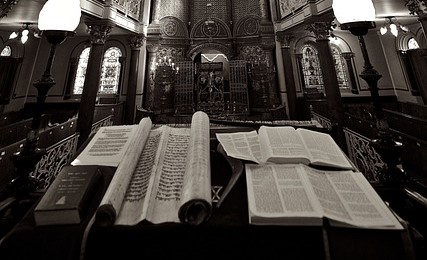
The next section directed at the Pharisees is concerning the Law of God. Jesus says, “The Law and the Prophets were until John; since then, the good news of the kingdom of God has been proclaimed, and everyone is strongly urged to enter it. But it is easier for heaven and earth to pass away than for one stroke of a letter in the law to drop out.” The Pharisees were notorious for interpreting the law to suit their own behaviors. We have seen a few examples of that already with the Sabbath. They were outward proponents for the Law, yet inside, they tried to create ways around the laws they didn’t like. Jesus makes it clear that the Law is still God’s Word. The change has come since John the Baptist in that the Law is now being fulfilled and the kingdom of God is being proclaimed. BUT – we are to note that Jesus never said the Law was obsolete. There is a difference between no longer being under the Law and the Law not being God’s holy word. The Law was never put into place to save us, but to show us our need to be saved. It is the bullseye we must hit, the perfect mark we must come to. Outside of Jesus, that is impossible. The Law is still intact and perfectly holy. This is why it is “easier for heaven and earth to pass away than for one stroke of a letter in the law to drop out.”
Jesus then gives us an example of one of the laws the Pharisees had tried to interpret to suit their own way. “Everyone who divorces his wife and marries another woman commits adultery, and everyone who marries a woman divorced from her husband commits adultery.” Jesus reminds them that marriage is still binding no matter how they want to twist the law to their own convenience. They had come up with several “reasons” a man could divorce his wife from if she burned his breakfast or if they just found someone they liked better. There was always a way they could turn it around to get their way. Jesus’ point? Even under the new covenant, God still cares about His Law and our obedience. If we truly believe God is the same yesterday today and tomorrow, then we must also believe His perfect Law is the same. Yes, we are under grace, but grace does not give license to disobedience. Paul says it best in Romans 6:15-18: “What then? Shall we sin because we are not under the law but under grace? By no means! Don’t you know that when you offer yourselves to someone as obedient slaves, you are slaves of the one you obey—whether you are slaves to sin, which leads to death, or to obedience, which leads to righteousness? But thanks be to God that, though you used to be slaves to sin, you have come to obey from your heart the pattern of teaching that has now claimed your allegiance. You have been set free from sin and have become slaves to righteousness. We seem to be under the mistaken impression that God has somehow relaxed His position on sin. He has not. The good news – He has also not relaxed His position on grace. There is grace for all who come to God in repentance, and there is strength from God, through the power of the Holy Spirit, to walk in righteousness.
Vs 19-31 “There was a rich man who would dress in purple and fine linen, feasting lavishly every day. But a poor man named Lazarus, covered with sores, was left at his gate. He longed to be filled with what fell from the rich man’s table, but instead the dogs would come and lick his sores. One day the poor man died and was carried away by the angels to Abraham’s side. The rich man also died and was buried. And being in torment in Hades, he looked up and saw Abraham a long way off, with Lazarus at his side. ‘Father Abraham!’ he called out, ‘Have mercy on me and send Lazarus to dip the tip of his finger in water and cool my tongue, because I am in agony in this flame!’ “’Son,’ Abraham said, ‘remember that during your life you received your good things, just as Lazarus received bad things, but now he is comforted here, while you are in agony. Besides all this, a great chasm has been fixed between us and you, so that those who want to pass over from here to you cannot; neither can those from there cross over to us.’ “‘Father,’ he said, ‘then I beg you to send him to my father’s house— because I have five brothers—to warn them, so they won’t also come to this place of torment.’ “But Abraham said, ‘They have Moses and the prophets; they should listen to them.’ “‘No, father Abraham,’ he said. ‘But if someone from the dead goes to them, they will repent.’ “But he told him, ‘If they don’t listen to Moses and the prophets, they will not be persuaded if someone rises from the dead.’”
This parable is different from others we have looked at in that Jesus gives a specific name to the poor man. The parable was told to his disciples and those particular Pharisees He had been addressing throughout this chapter. In it, Jesus makes several points.
1 – there is a great divide between the two men throughout the parable.
2 – there are consequences for the life you lead
3 – there will be those who will not believe even when evidence hits them in the face

First – there is a great divide between the two men in both life and death. In life we find a very wealthy guy and an extremely poor man. The wealthy man had everything in this life that made him comfortable – good food, fine clothes, a lavish lifestyle… The poor man had everything going against him in this life – crumbs for food, sores for his clothing and dogs licking his sores. While the wealthy man would have been able to go to synagogue and worship, Lazarus would have been considered unclean and left out. Things couldn’t be more polar opposite! As we know Jesus was speaking to the Pharisees, they had to be just a bit uncomfortable with where they saw this story going. As we learned earlier in verse 14, these guys were lovers of money. They liked the lifestyle that came with having a lot of wealth. They knew Jesus was comparing them with this rich man and they had to be wary of His ultimate point.

Second – there are consequences for the life you lead. When these two men died, they once again found themselves in a great divide – just turned around. Lazarus was carried away by angels to Abraham’s bosom and the wealthy man found himself in Hades. To be clear, the word Hades does not necessarily mean Hell. It literally means the unseen place or the abode of the dead. This had to be a slap in the face for the Pharisees. They had long seen themselves as the sons of Abraham, yet here, Jesus has placed them as far away as they can get from Father Abraham. Instead, Lazarus, who was unclean and unfit to worship in the synagogue or temple in his lifetime, is now by Abraham’s side. There are consequences for what you do in this life. Jesus said it another way in Matthew 25:41-45; “Then he will say to those on his left, ‘Depart from me, you who are cursed, into the eternal fire prepared for the devil and his angels. For I was hungry and you gave me nothing to eat, I was thirsty and you gave me nothing to drink, I was a stranger and you did not invite me in, I needed clothes and you did not clothe me, I was sick and in prison and you did not look after me.’ “They also will answer, ‘Lord, when did we see you hungry or thirsty or a stranger or needing clothes or sick or in prison, and did not help you?’ “He will reply, ‘Truly I tell you, whatever you did not do for one of the least of these, you did not do for me.’ As we have observed before, there is nothing wrong with wealth. There is something wrong with hording and ignoring. To amass wealth here in earth is a wasted effort. God blesses us with the things we have so we can in turn be a blessing to those around us. This is what the rich man ignored and, in the end of all things, he paid for it dearly. We are stewards with all God has given us. Mother Teresa once said, “I’m a little pencil in the hand of a writing God, who is sending a love letter to the world.” In other words, lets be allow ourselves, and all we have, to be the hands and feet, the tools, that God can use to spread His love throughout the world.
Third – there will be those who will not believe even when evidence hits them in the face. Jesus plainly teaches that all we need to know is right there in Scripture. The Prophets and Moses have spoken. The Messiah is revealed in all of scripture. He is indeed revealed in Creation itself. Romans 1:18-20 says, The wrath of God is being revealed from heaven against all the godlessness and wickedness of people, who suppress the truth by their wickedness, since what may be known about God is plain to them, because God has made it plain to them. For since the creation of the world God’s invisible qualities—his eternal power and divine nature—have been clearly seen, being understood from what has been made, so that people are without excuse. Nothing else needs to be added – and indeed nothing added will make a difference to those who refuse to see. If we are blinded by our focus on wealth, then it will be impossible to see and serve God.

The point Jesus wants the Pharisees, and indeed us, to take away is what He said in verse 13 of this chapter – you can’t serve both wealth and God. It is so easy to become enslaved to money and to all it can bring us. I point to Charles Dickens’ A Christmas Carol as an example. The main character is Scrooge, a very wealthy man whose wealth became his master. he is a self obsessed, manipulative, greedy, man lacking in any kind of empathy for his fellow man – and proud of it. In the beginning of the story Scrooge encounters his old partner Marley’s ghost. I think Dickens writes the best line in the entire book here. As a rebuttal to Scrooge’s comment about how great of a business man Marley was, he says, “Mankind was my business. The common welfare was my business; charity, mercy, forbearance, and benevolence, were, all, my business. The dealings of my trade were but a drop of water in the comprehensive ocean of my business!” And, indeed, this is our business. God has given us gifts, both monetarily and otherwise, to use in spreading His love. We are to store up treasures in heaven. Turning our eyes off ourselves and looking around to find how God can use us to glorify His name and further His kingdom through the resources He has given us is one of the many ways to store that treasure up.
 Bible Study Blog