At The Cross
We have finally come to the cross of Christ. For three years, Jesus taught, discipled, healed, fed and lived among the people. Now, He is about to go to the cross for them, and us.
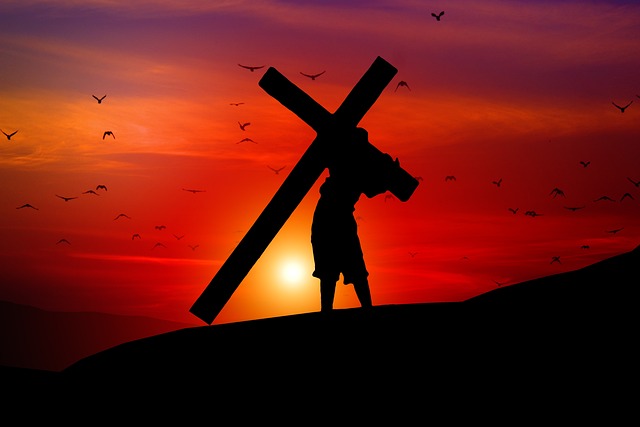
Vs 26-31 As they led Him away, they seized Simon, a Cyrenian, who was coming in from the country, and laid the cross on him to carry behind Jesus. A large crowd of people followed Him, including women who were mourning and lamenting Him. But turning to them, Jesus said, “Daughters of Jerusalem, do not weep for Me, but weep for yourselves and your children. Look, the days are coming when they will say, ‘The women without children, the wombs that never bore and the breasts that never nursed, are fortunate!’ Then they will begin to say to the mountains, ‘Fall on us!’ and to the hills, ‘Cover us!’ For if they do these things when the wood is green, what will happen when it is dry?”
Those who are going to be crucified were required to carry their own cross – at least the cross beam of the cross. The cross would have weighed around 300 lbs. with the cross beam weighing around 75-125 lbs. After the beatings and scourging Jesus suffered just a few hours before, He was in no condition to carry the cross all the way to Golgatha. On the way out, they forced a man by the name of Simon, a Cyrenian to carry the cross. He had come into Jerusalem from Cyrene, which is modern day Libya, for the Passover. He probably traveled at least 800 miles, and it would have taken him about a month to make the journey. He finds his way there, only to be commandeered to carry a cross for someone he doesn’t even know. I’ve always wondered what became of him. Did he stay at the cross and watch the proceedings? Did he come to follow the man who’s cross he bore? There is some evidence to say that he did. The book of Mark names his sons, which suggests there were further conversations with him by at least one of the disciples. They forced a man coming in from the country, who was passing by, to carry Jesus’ cross. He was Simon, a Cyrenian, the father of Alexander and Rufus. Mark 15:21
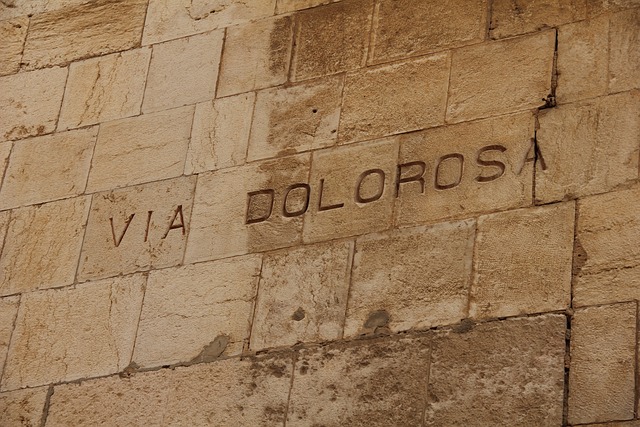
As was the custom, there were large crowds following the procession of those being crucified. If you have ever been to the old town of Jerusalem, and have walked what is known as the Via Dolorosa, you will know it is a long winding path through very narrow streets. The crowds in those tight alleyways would have made it very difficult to walk carrying a cross beam. Some would have been shouting, others mocking, while still others would have been weeping. It is to those weeping women that Jesus would give His last discourse: “Daughters of Jerusalem, do not weep for Me, but weep for yourselves and your children. Look, the days are coming when they will say, ‘The women without children, the wombs that never bore and the breasts that never nursed, are fortunate!’ Normally, it is the other way around – those who bear children are the fortunate ones and those who are barren are to be pitied. But, Jesus knows what is going to happen in just a few years. He knows the horror that will befall Jerusalem and so He quotes Hosea 10:8: Then they will begin to say to the mountains, ‘Fall on us!’ and to the hills, ‘Cover us!’ For if they do these things when the wood is green, what will happen when it is dry?” At the same time, He knows what sin has done and continues to do. If they would do these things to an innocent man (the wood is green), what is going to happen to the guilty (the dry wood). He is saying, Don’t lament me, lament your sin that destines you to separation from a holy God.
Vs 32-43 Two others—criminals—were also led away to be executed with Him. When they arrived at the place called The Skull, they crucified Him there, along with the criminals, one on the right and one on the left. Then Jesus said, “Father, forgive them, because they do not know what they are doing.” And they divided His clothes and cast lots. The people stood watching, and even the leaders kept scoffing: “He saved others; let Him save Himself if this is God’s Messiah, the Chosen One!” The soldiers also mocked Him. They came offering Him sour wine and said, “If You are the King of the Jews, save Yourself!” An inscription was above Him: THIS IS THE KING OF THE JEWS. Then one of the criminals hanging there began to yell insults at Him: “Aren’t You the Messiah? Save Yourself and us!” But the other answered, rebuking him: “Don’t you even fear God, since you are undergoing the same punishment? We are punished justly, because we’re getting back what we deserve for the things we did, but this man has done nothing wrong.” Then he said, “Jesus, remember me when You come into Your kingdom!” And He said to him, “I assure you: Today you will be with Me in paradise.”
In this passage, Luke gives us an in-depth picture of what took place in the hours Jesus was on the cross. He was crucified at Golgotha, or the place of the Skull. There were three crucifixions that day and he was placed in between two criminals. He was literally surrounded by sin on both sides as all the sin of the world would come upon Him. He looks out from the cross and proclaims forgiveness. He is the unblemished Passover Lamb. All who come to Him will be covered by His blood. He is the pure untainted Bread of Life. Everyone who eats what He offers will have eternal life. Psalm 34:8 says, Taste and see that the Lord is good. How happy is the man who takes refuge in Him! He is the Cup of Redemption. Forgiveness is held out as a gift for all who will take it. He is the very fulfillment of all Scripture, yet, the people scoffed and mocked Him and the soldiers cast lots for his clothes. Even one of the criminals mocked and insulted Him. But the other criminal came to an understanding. He realized what was happening and made a declaration. “Don’t you even fear God, since you are undergoing the same punishment? We are punished justly, because we’re getting back what we deserve for the things we did, but this man has done nothing wrong.” He confessed his sin, reached out to the Messiah and was granted immediate forgiveness. It is the picture of what can happen when we come to the Messiah in humility, confessing our own sin. He is faithful and just and will forgive us our sin. We will be redeemed. We will taste the goodness of God.

Vs 44-49 It was now about noon, and darkness came over the whole land until three, because the sun’s light failed. The curtain of the sanctuary was split down the middle. And Jesus called out with a loud voice, “Father, into Your hands I entrust My spirit.” Saying this, He breathed His last. When the centurion saw what happened, he began to glorify God, saying, “This man really was righteous!” All the crowds that had gathered for this spectacle, when they saw what had taken place, went home, striking their chests. But all who knew Him, including the women who had followed Him from Galilee, stood at a distance, watching these things.
At about noon, three things happened that turned the world upside down. First, in the middle of the day, it became dark for almost three hours. This event is referred to by Phlegon of Tralles, a Greek writer, in one of his The Olympiads books. He says there was, “the greatest eclipse of the sun. It became night in the sixth hour (noon) of the day so that stars even appeared in the heavens. There was a great earthquake in Bithynia, and many things were overturned in Nicaea.” Second, the curtain of the sanctuary was split down the middle. This may not sound like much to the average person, but this was not an ordinary curtain. This curtain, or veil, separated the Holy Place of the tabernacle from the Holy of Holies where the Ark of the Covenant was kept. This was the place where the Shekinah Glory of God resided. It was about 60 feet long, 30 feet high and 4 inches thick. It formed a barrier between the Glory of God and man. Only the high priest could enter once a year on Yom Kippur to beg for forgiveness for the people. This veil wasn’t only ripped, it was ripped from the top to the bottom. Only God could have rent the veil in two. Hebrews 10 tells us why this separation was no longer needed: “Now where there is forgiveness of these, there is no longer an offering for sin. Therefore, brothers, since we have boldness to enter the sanctuary through the blood of Jesus, by a new and living way He has opened for us through the curtain (that is, His flesh), and since we have a great high priest over the house of God, let us draw near with a true heart in full assurance of faith, our hearts sprinkled clean from an evil conscience and our bodies washed in pure water.” Hebrews 10:18-22.
Jesus then calls out in a loud voice and says, “Father, into Your hands I entrust My spirit.” Although Luke does not record it, John 19:30 tells us what Jesus cried out: “It is finished.” The Greek word for this phrase is tetelestai, which means to bring to an end, to complete, to fulfill. At that moment, Jesus became the fulfillment of all Scripture. He completed what He came to do, and then, He entrusted His spirit into His Father’s hands. This act obviously had an impact on everyone around as the centurion guarding the area began to glorify God, while others began beating their chests. The only friends Jesus had close by were His mother and John. Everyone else watched from afar.
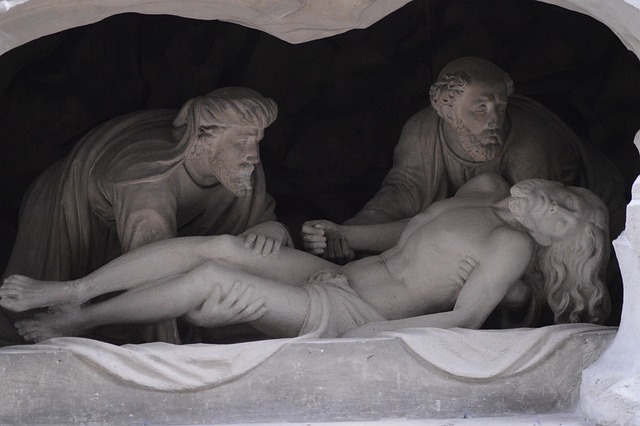
Vs 50-56 There was a good and righteous man named Joseph, a member of the Sanhedrin, who had not agreed with their plan and action. He was from Arimathea, a Judean town, and was looking forward to the kingdom of God. He approached Pilate and asked for Jesus’ body. Taking it down, he wrapped it in fine linen and placed it in a tomb cut into the rock, where no one had ever been placed. It was preparation day, and the Sabbath was about to begin. The women who had come with Him from Galilee followed along and observed the tomb and how His body was placed. Then they returned and prepared spices and perfumes. And they rested on the Sabbath according to the commandment.
We find that not all the Sanhedrin was in league against Jesus. We know Nicodemus was a believer and now we find another man who was seeking the kingdom of God. His name was Joseph from Arimathea. It was the custom for people to be left on the cross, but, during the Passover season, the Romans granted the Jews the ability to bury the dead. In this way, Jesus body was not defiled. It says Joseph laid Him in a tomb that had not been used before. This was a very expensive gift of mercy indeed. What he didn’t know is that his tomb would not be needed for long. In a few days, he would discover more than he ever dreamed of. Because it was the preparation day for the Sabbath, they didn’t have a long time to prepare and bury the body completely, so they did what they could and then rested on the Sabbath. Their intention was to come back after the Sabbath to complete the process. And so, we wait.
There were many people at the cross that day. Simon the Cyrenian who carried the cross of Christ. The Roman soldiers who cast lots for his clothing. The criminals on either side – one mocking and the other looking for mercy. The centurion who was impacted by what he experienced that day. The people and Pharisees who laughed and mocked. The disciples and women who watched from afar. Joseph of Arimetha who gave up an expensive tomb for Jesus’ body. And then there is us. Jesus says, Father forgive them because they don’t know what they are doing. He said It is finished – I have fulfilled it – the price has been paid in full. His mercy and grace is for all who would come to the cross. The question is, how do we come? Do we come ready to carry our cross for Christ? Do we come looking for some way to benefit? Are we impacted as we experience God’s outpouring mercy? Do we stand off in a distance just watching? Do we mock and laugh? Are we ready to give what we can for God’s kingdom? To all these, Jesus offers mercy and grace. He has finished it. It is paid in full. The only question left is – will you except His gift?
 Bible Study Blog